
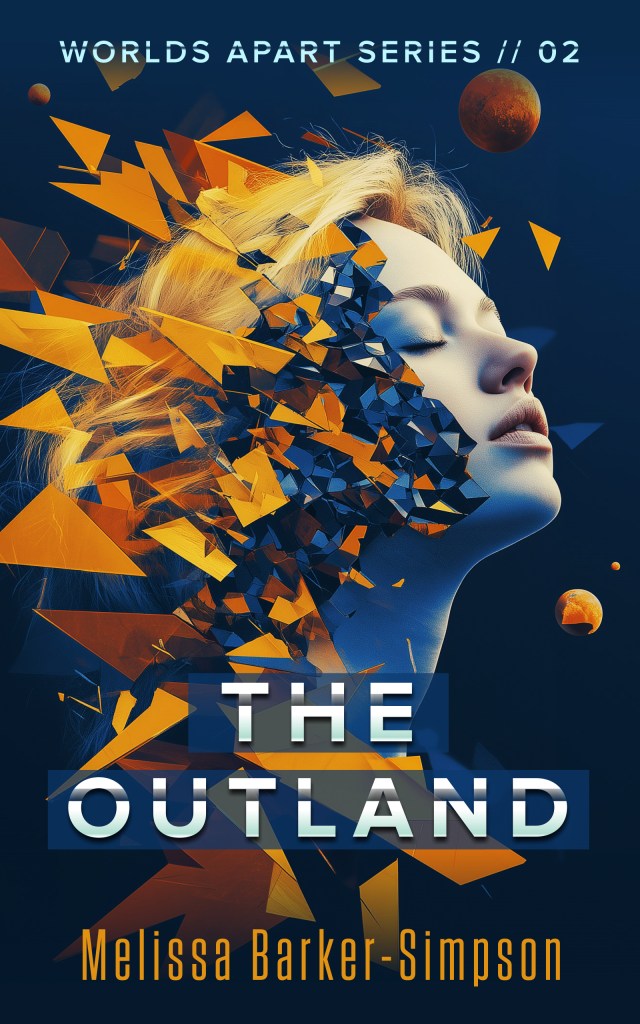
Available 31 July 2025
Embracing her role as the Fifth Watcher, Audrey Montgomery has made a home in the Outland. As the bridge between the Continuum and those who live within it, her mission is clear: identify and protect Outlanders, those born between worlds.
When Saffron Jenkins, a gifted Outlander, begins experiencing disturbing mental intrusions, it soon becomes clear she’s being hunted—not in the physical world, but through Borrowing, a dangerous process that allows a killer to slip into her mind.
Revealing just enough to torment her, but never enough to be caught, the predator plays a chilling game of cat and mouse. As the connection deepens, Saffron must work with Audrey, Hunter—Audrey’s second-in-command—and her own underground network to unravel a conspiracy that threatens not only her sanity, but the safety of the entire Continuum.
1. What inspired the concept of your multiverse and characters like the Watchers or Resonators?
The idea sparked during an ordinary day out with a friend. We were walking through a town centre when I caught our reflections in a shop window. In that moment, everything—the people passing by, the colours, the chaos and beauty of the world—was mirrored back at us.
That reflection made me wonder: What if this wasn’t just a mirror? What if it was a window into another version of this place?
Would their town look the same? Would people walk the same streets, make the same choices? Or would something—subtle or startling—be different?
Those questions kept echoing in my mind, and from them, the first Observer was born: a traveller of the multiverse who can see into other realities using reflective surfaces.
2. How does your universe explore identity through alternates and consciousness?
To be honest, even though I play around with parallel universe theory and alternates, it’s not really about characters bumping into other versions of themselves—except for Audrey Montgomery, who’s met a few!
It’s more about characters discovering who they are by being tested. Identity in my universe comes out through the journey—the challenges they face, the relationships they form, and what they learn about themselves along the way.
Take Audrey, for example. In the first book, she meets two different versions of a brother she doesn’t have in her home universe—she’s an only child there. The impact of that loss and the deep, immediate connection she feels to Lucas really shape her and how she sees the world.
As for consciousness, that comes into play with a group of travellers known as Borrowers. They’re able to pair their consciousness, usually with an alternate version of themselves in another universe, although that’s not always necessary. Some can link with any mind, as long as there’s some kind of connection between them.
It must be a terrifying thing, having someone else inside your head, knowing they can see what you see and feel what you feel. Even for experienced travellers who know that other worlds exist, such a profound invasion of self is unsettling. It’s a concept I’m looking forward to exploring even more as the series goes on.
3. What are Watchers, Weavers, or Observers—and how do their powers shape the narrative?
There are lots of ways to travel in my universe, and not all of them are physical. Observers travel by using reflective surfaces—they slip through the multiverse in this way (I discussed them earlier).
Weavers move through a dreamscape. They explore other universes while in a sleep-state, though usually, they can’t interact with the people they meet there—more like watching echoes or memories than stepping into a scene.
Watchers are different again. You could say they’re like guardians of the multiverse—ancient beings woven into the very fabric of the Continuum. They can take on physical form, but that form is just a representation. There were originally four Watchers, each representing a strand of the Continuum. But Audrey Montgomery ascended to that role, making five. She acts as a bridge, a kind of frontline guardian. And trust me, that changes everything.
4. How do you keep track of different universes, timelines, or character arcs?
Scrivener! It’s a brilliant program and helps me keep everything organized. I know other writers use things like Miro boards or Notion, but Scrivener works for me.
That said, I used to be completely analogue—scribbles in a physical file, a giant whiteboard covered in maps, images, notes… chaos, but creative chaos. World-building tends to take over my space (and sometimes my life)!
5. Do you start with characters or concepts first—and why?
Usually, the characters. Even when I have the concept, like with Worlds Apart, the character starts to shape themselves in my head and almost begins telling the story on their own.
I’ve got so many characters living up there. I don’t do much in the way of rigid planning—the story unfolds through them. I’m just the conduit.
6. What books, shows, or creators have influenced your work the most?
I read widely and watch just about everything—sci-fi, drama, thrillers, fantasy. I love getting lost in someone else’s story. I think my biggest influences come from all over, really. I enjoy flipping ideas on their heads and seeing how far they can stretch. I’m drawn to the unexpected.
7. What can new readers expect from your story in terms of tone, pace, and themes?
Fast-paced and action-packed! When I was younger, I used to read my stories aloud to my dad, and he’d always laugh because if something catastrophic could happen, I made sure it did—think San Andreas on steroids!
I’ve slightly toned that down, but at their core, my stories are about connection. About people working together, fighting to do what’s right, and finding strength in each other. I also write strong women, because I come from a long line of them—and that strength always finds its way into the page.
8. If you could spend a day with one of your characters, who would it be and why?
This might surprise some readers, but I’d probably choose Taylor—and we still don’t know her last name (not even me).
She’s an enigma. At the centre of the Continuum is the Hub—a kind of interdimensional crossroads and the base for the IDOLS (Interdimensional Officers of the Law). Taylor commands the IDOLS. She’s sharp, ruthless, runs the Hub with an iron fist… and I want to know what makes her tick. When the time’s right, I’ll find out.
9. How can readers connect with you or dive deeper into your universe?
I love hearing from readers! You can connect with me in all the usual places (listed at the end of the interview). I’ll also be releasing a Guide to the Continuum very soon on the website, so if you’re new to this world, that’s a great place to start.
10. What’s coming next in your series or world—and how can fans stay updated?
Next up: another season of my Labno & Carter podcast. After that, I’m diving back into the Collective series. Book 4 is Kayde’s story, and I’m eager to share it.
If you want sneak peeks, cover reveals, giveaways, and behind-the-scenes stuff, the best way to stay in the loop is to join my newsletter.
 Melissa Barker-Simpson
Leave a comment